The Challenge
Transforming Hill Learning Center’s esteemed, in-person Executive Function workshop into a fully online format required bridging the gap between immersive, face-to-face interaction and asynchronous digital learning. For years, educators traveled to Durham, NC, to experience an interactive, high-touch training environment with proven success. The core challenge in 2025 was scaling that localized, highly regarded experience for a broader national audience of teachers and parents without diluting its practical value. Instructional designers and animators needed to translate complex neurological concepts—specifically the 11 distinct executive function skills—into online modules that remained dynamic, engaging, and directly applicable to classroom realities.
Beyond content translation, the primary pedagogical hurdle was designing for action rather than passive consumption. Because executive function skills like goal-directed persistence and response inhibition are stronger predictors of academic success than IQ, the course could not simply deliver information; it had to build concrete coaching competencies. The layout needed to guide educators through evaluating real-world student behaviors, recognizing the compounding impacts of ADHD and learning differences, and independently designing and executing targeted coaching intervention plans. Balancing high-level cognitive theory with turnkey, actionable tools formed the central design challenge of turning Hill’s long-standing expertise into an impactful digital learning environment.
The Solution
Our solution centered on an intuitive, scaffolded course architecture paired with relatable, real-world application. The journey begins with foundational introductory modules—including a dedicated module on coaching principles—that establish the mindsets and frameworks needed before diving into specific skills. From there, the curriculum unfolds through 11 dedicated, numbered modules, each systematically unpacking a distinct executive function skill. To ground these abstract cognitive concepts in human terms, we introduced a recurring cast of relatable student, teacher, and family characters, giving learners a consistent narrative thread to connect with across the entire course.
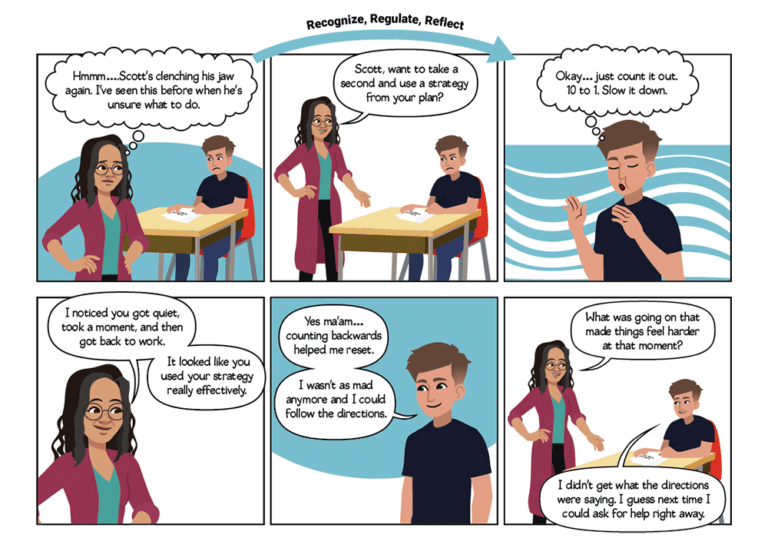
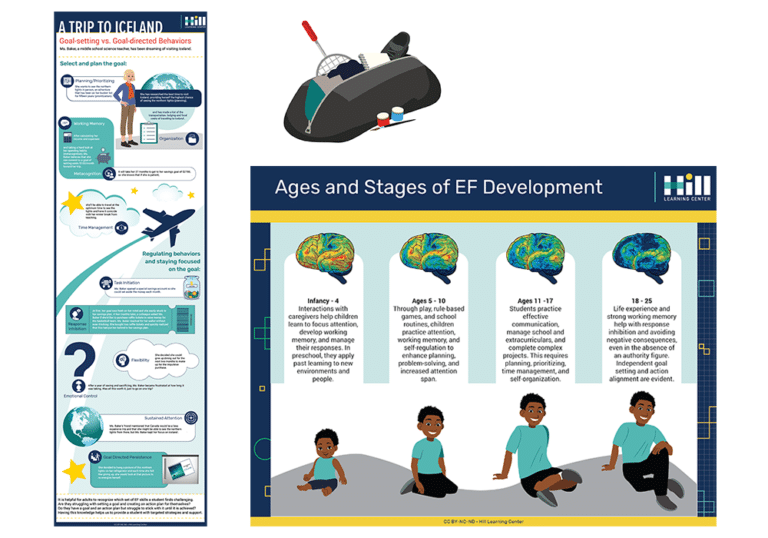
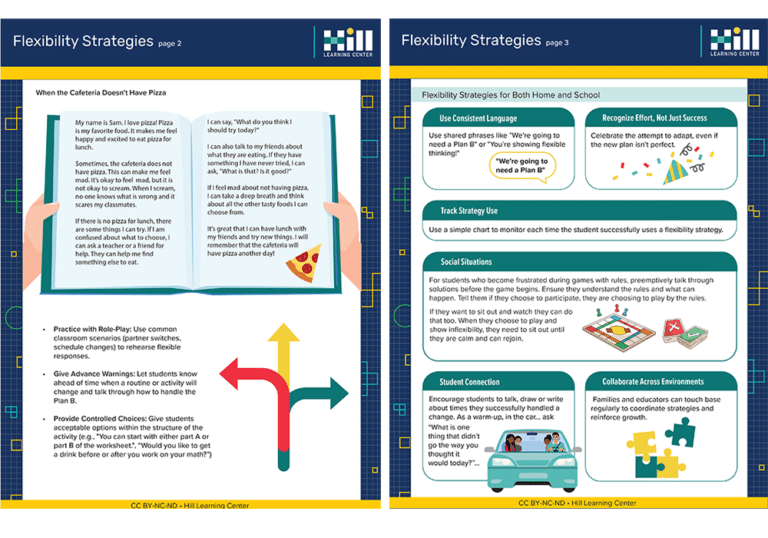
Each skill-building module was meticulously structured to move educators from foundational understanding to confident execution. Every module opens with a custom animated scenario starring our established characters, illustrating what a specific executive function challenge looks like in everyday life, complemented by an expert tip from renowned practitioner Peg Dawson. Learners then explore clear skill descriptions alongside side-by-side comparative charts that contrast student strengths with specific areas of struggle. To ensure educators leave with concrete tools, each module delivers actionable teaching strategies, step-by-step handouts, visual guides, and a structured “I Do, We Do, You Do” coaching graphic to guide intervention planning.
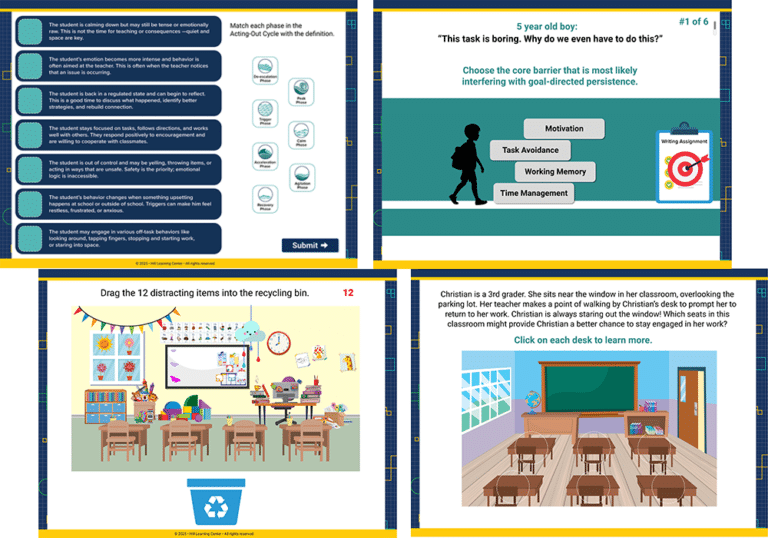
The capstone of each module is an interactive applied-learning object that bridges theory and practice. Rather than relying on passive quizzes, learners navigate branching, real-world scenarios where they must analyze student behaviors and select the most effective coaching strategies for that character’s specific needs. This practical, scenario-based approach ensures teachers do not just absorb information about executive function, but actively practice evaluating, coaching, and supporting striving students in a safe, simulated environment before bringing these skills into their own classrooms.
Learn more and sign up for this online course at Hill Learning Center’s website: https://www.hillcenter.org/professional-learning/executive-function